NAD+ Therapy: An Honest Look at What We Know, and What We Don't, in 2026
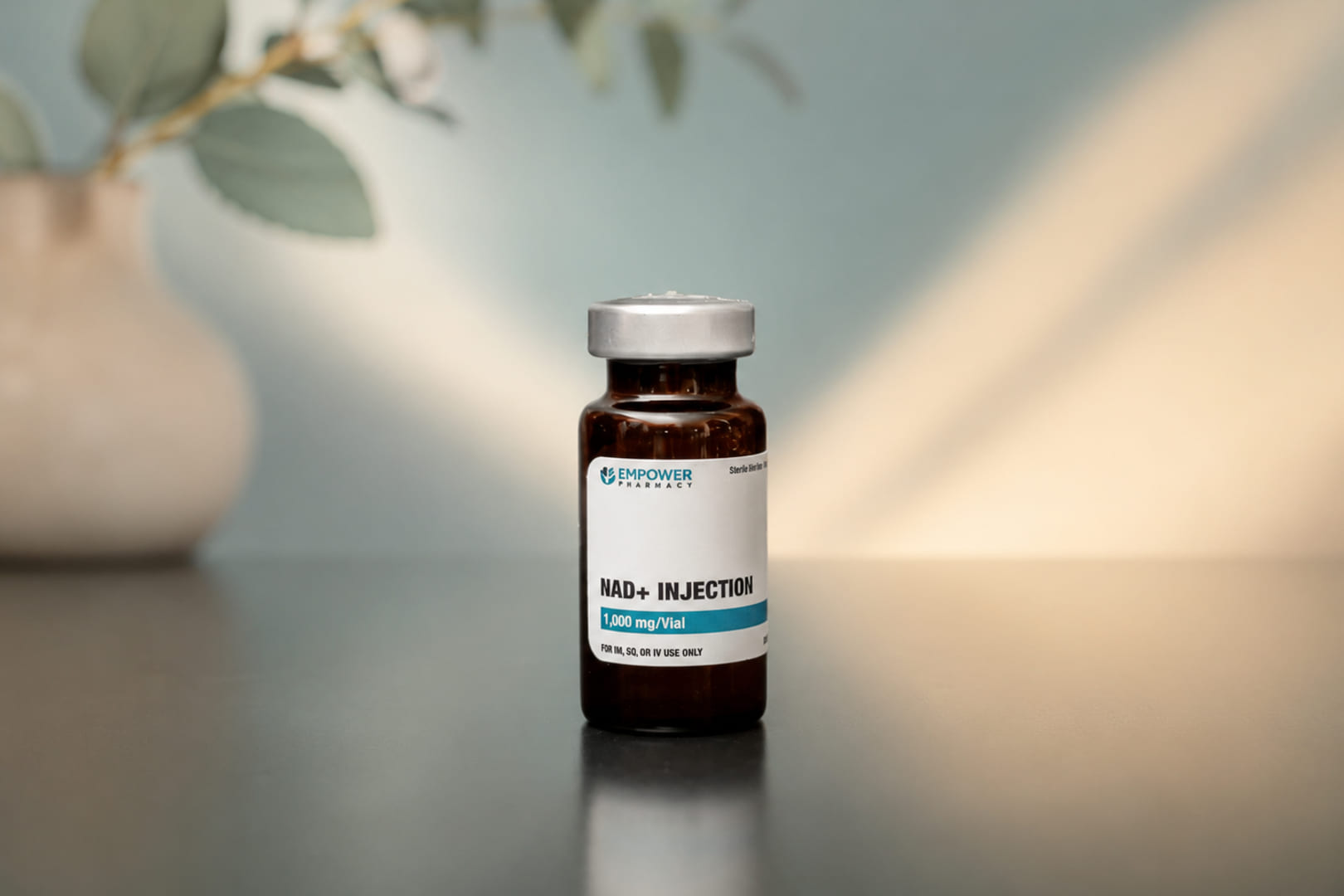
NAD+ is having a moment.
Every other longevity podcast has a guest swearing it gave them their twenties back. Med spas are running NAD+ specials like it's Botox. Clients show up to our clinic asking about it before they even ask about their hormones.
Real talk: I've sat through a few of those podcasts and rolled my eyes. I've also had clients I trust look me in the face and tell me they feel measurably different on it. Both of those things can be true at the same time, and that tension is exactly why this post exists.
So I want to do something a little unusual for a clinic blog. I want to tell you the truth about what we actually know, and what we don't, about NAD+ therapy in 2026. Not the marketing version. The version I'd tell my sister.
What NAD+ Actually Is (In Plain Language)
NAD+ stands for nicotinamide adenine dinucleotide. It's a coenzyme. Every cell in your body uses it, and a lot.
The short version: NAD+ is the molecule that helps your mitochondria turn the food you eat into the energy your cells run on. It also activates a family of proteins called sirtuins (involved in things like DNA repair and cellular stress response), and it's a cofactor for enzymes that fix damaged DNA. If your cells were a factory, NAD+ would be both the electricity bill and the maintenance crew.
The reason it became a buzzword: NAD+ levels decline measurably with age. The biology here is well-described. A 2022 review in regenerative medicine walks through how falling NAD+ correlates with mitochondrial dysfunction, neurodegeneration, and the metabolic slowdown people experience as they get older. The hypothesis that follows is intuitive: if NAD+ goes down and bad things happen, raise NAD+ and things will get better.
That's a reasonable hypothesis. Whether it works the way the marketing implies is a different question.
Why I'm Going to Be Really Honest With You
Here's the part I don't see clinics talk about. The evidence for NAD+ therapy (especially IV and injectable NAD+) is much thinner than the marketing suggests.
I'm a nurse practitioner first, and a clinic owner second. I'm only useful to you if I tell you the real picture, even when "the real picture" doesn't make a tidy sales pitch. So let's go through what the published science actually shows, and where we're still extrapolating.
What the 2025-2026 Research Actually Shows
A PRISMA-guided systematic review published in 2026 looked at every published study on NAD+ supplementation for anti-aging and wellness through October 2025. Their finding, in plain English: there are no eligible outcomes trials testing IV or intramuscular NAD+ for anti-aging or wellness endpoints. None. Most of the stronger evidence we have for NAD+ supplementation is for the oral precursors (nicotinamide riboside or NR, and nicotinamide mononucleotide or NMN), and even there the human outcomes data is early.
That doesn't mean NAD+ doesn't work. It means we don't yet have the kind of controlled human trials that would let us say with confidence that an NAD+ injection will give you more energy, improve aging markers, or move specific health endpoints. Earlier systematic reviews have come to similar conclusions. There's promising biology, some small clinical case series, and a lot of patient-reported outcomes, but the gold-standard randomized data isn't there for IV or injectable NAD+.
What we do have:
- Strong preclinical (animal and cell-culture) evidence that raising NAD+ improves mitochondrial function and cellular stress responses.
- Small pilot studies in humans showing that NAD+ administration is generally tolerable when given slowly and at reasonable doses.
- Better-quality emerging data for nicotinamide riboside (NR), which is structurally related to NAD+ and appears to be better tolerated.
- Patient-reported improvements in energy, mental clarity, and recovery in many real-world settings, though these are subjective and not from controlled trials.
So when you hear someone say "NAD+ will reverse your biological age," what you're hearing is mechanism extrapolated into outcome. The mechanism is plausible. The outcome is not yet proven in well-controlled human trials for IV or injectable NAD+.
Why We Still Offer NAD+ at GlowCo (And How)
You might reasonably ask: "Okay, if the evidence is thin, why is it on your menu?"
A few reasons, and I want to be honest about each one.
- The mechanism is real. NAD+ does what we say it does inside cells. We have decades of biochemistry showing how this coenzyme works.
- Many patients report meaningful subjective benefit. I won't pretend the testimonials don't exist, including from people I trust. Subjective doesn't mean fake. It just means we haven't proven the mechanism of the benefit is what people think it is (versus, say, a placebo response, or the rest of life slowing down for the hour they sit and rest while it's working).
- The safety profile is reasonable when it's done right. Side effects are mostly limited to the administration itself (nausea, flushing, abdominal cramping, headache), and they resolve when you slow the dose down or split it.
- We use it conservatively, and we use it our way. At GlowCo, we offer NAD+ exclusively as a subcutaneous (SubQ) injection. No IV drip. No long infusion appointments. We chose that route on purpose, because SubQ tends to be much better tolerated than the high-dose IV protocols you see on social media, and the realistic dosing makes more sense for the actual evidence base. We dose lower than the longevity podcasts recommend. We source through accredited compounding pharmacies. And we set realistic expectations.
What we won't do: tell you it will reverse your aging, repair your DNA, or replace the basics (sleep, lifting heavy things, protein, real food). Anyone selling NAD+ that way is selling a story, not a treatment. That's not how we work.
Side Effects: What to Actually Expect
If you've ever had a NAD+ IV at a clinic that ran the drip too fast, you remember it. The most common side effects during NAD+ administration are:
- Nausea
- Flushing or feeling warm
- Abdominal cramping or "chest tightness"
- Headache
- Sweating or general malaise
These are dose- and rate-dependent. The reason we lean into SubQ dosing is exactly this: patients tend to tolerate it much better than fast IV pushes, even if the peak blood levels are lower. Recent 2026 pilot data also suggests that NR (a related precursor) may have even better tolerability than NAD+ itself when given parenterally, which is an interesting development worth watching.
One more thing worth mentioning: the FDA has warned about contamination risks and documented adverse events associated with compounded injectable NAD+ products. This is precisely why source matters. Every NAD+ product we use comes from an accredited, U.S.-based compounding pharmacy with documented quality control. If you ever get NAD+ elsewhere, ask where it was compounded and how it's tested. If the answer is fuzzy, walk away.
Want to talk through whether NAD+ makes sense for you?
Come in for a real conversation. We'll go over your goals, your labs, your budget, and whether this is the highest-leverage thing for you right now.
Book a Consultation
Cost, Frequency, and Insurance
These are the most-asked questions in our office, so let me answer them directly.
Cost: Our NAD+ SubQ program starts at $100/month for the Essentials plan (25 mg weekly), $200/month for Performance (50 mg weekly), and $350/month for Restoration (100 mg weekly). The first dose is in-office; after that, most patients self-administer at home. Walk-in weekly injections at our Gilbert clinic are also an option if you'd rather not self-inject.
Insurance: NAD+ therapy isn't covered by insurance. It's not an FDA-approved indication for any condition we use it for, and compounded medications generally aren't reimbursed by commercial plans. HSA/FSA cards are often accepted.
Frequency: Most patients inject weekly. Some find that a maintenance rhythm of every other week works for them after an initial loading phase. We'll talk through what fits your goals and life.
When you'd notice anything: Most patients who do notice changes (energy, mental clarity, recovery) report them within the first 2-4 weeks. If you've done a few months and feel nothing, the honest answer is it probably isn't doing much for you, and we should redirect that money toward something with more leverage.
Who Probably Shouldn't Bother (Yet)
This is the section that a typical med spa won't write, but it's the most important one. NAD+ is probably not the best first move if:
- You haven't checked your hormones. If you're a perimenopausal woman with crashing testosterone and estradiol, NAD+ is not going to fix what HRT would. Test first. Optimize the cheap, well-evidenced thing before reaching for the experimental one.
- You haven't fixed sleep. No injection will out-perform consistent 6-hour nights. If you're chronically sleep-deprived, work on that first.
- You're hoping it will replace effort. NAD+ doesn't build muscle, doesn't change your metabolism in any clinically meaningful way, and doesn't replace consistent strength training and adequate protein.
- The budget is tight. If you have to choose between a NAD+ subscription and seeing a real provider to optimize your hormones and metabolic health, choose the provider visit every time. NAD+ is an add-on, not a foundation.
It can make a lot of sense for someone who's already done the foundational work: sleep is dialed, hormones are optimized, training is consistent, nutrition is in order, and wants an additional tool to support recovery, energy, and cellular health as they age. For that person, the honest answer is "the biology is plausible, the safety is reasonable, the outcomes data is still maturing, and many patients report meaningful benefit." That's a defensible place to start. It's not a miracle. That's not how we work.
Common Questions
What is NAD+ therapy?
NAD+ therapy is the administration of supplemental nicotinamide adenine dinucleotide (a coenzyme involved in energy production, DNA repair, and cellular signaling) through IV infusion, intramuscular injection, or subcutaneous injection. The goal is to raise systemic NAD+ levels, which decline with age. At GlowCo, we offer NAD+ exclusively as a subcutaneous injection.
Is NAD+ therapy FDA-approved?
No. NAD+ is not FDA-approved for anti-aging, longevity, energy enhancement, or any wellness indication in the United States. It's offered as a patient-specific compounded preparation through licensed compounding pharmacies.
Is NAD+ therapy safe?
When sourced from accredited compounding pharmacies and administered at appropriate doses, NAD+ therapy has a reasonable short-term safety profile in healthy adults. Side effects are mostly administration-related (nausea, flushing, cramping, headache) and resolve quickly. Long-term safety data is limited.
Does NAD+ therapy actually work?
As of 2026, no large randomized controlled trials have shown that IV or injectable NAD+ produces specific wellness or anti-aging outcomes in humans. The biological mechanism is well-described, and many patients report subjective benefits, but the gold-standard outcomes evidence isn't there yet.
How often should I get NAD+ injections?
Most patients on our SubQ protocol inject weekly. After an initial loading phase, some patients adjust frequency based on goals and how they feel. There isn't a single universal best frequency yet; we tailor it to the person.
What does NAD+ feel like?
With SubQ dosing at reasonable amounts, most patients feel very little during the injection itself. With faster IV administration, some people experience a warm flush, mild nausea, or pressure in the chest or stomach, which is one of the reasons we don't use that route. In the days after, patients sometimes report a subtle lift in energy or mental clarity, though this is highly individual.
The Bottom Line
NAD+ is real biology, with promising mechanism and emerging human data, surrounded by a marketing layer that has gotten way out ahead of the evidence. We offer it because we think it's a reasonable option for the right person, used conservatively, with realistic expectations and clean sourcing. We don't offer it as a miracle. We offer it as a tool.
If you want to talk through whether it makes sense for you, or if you'd be better served by hormones, sleep work, or a different peptide stack, that's what a consultation is for. The most valuable thing we offer isn't any single injection. It's a clinician who will tell you when something isn't the right move.
Curious whether NAD+ is right for you?
Schedule a no-pressure consultation. We'll talk through your goals and tell you honestly where the highest-leverage place to start is, even if it's not NAD+.
Schedule a Consultation or call 480-770-2633.
Real relationships. Real results.
This article is for educational purposes and is not medical advice. NAD+ therapy is not FDA approved for any wellness or anti-aging indication. Always consult a qualified healthcare provider before starting any new treatment.
Sources
Gallagher C, Emmanuel OO. NAD+ supplementation for anti-aging and wellness: A PRISMA-guided systematic review of preclinical and clinical evidence. Ageing Research Reviews, 2026.
Gindri IM, Ferrari G, Pinto LPS, et al. Evaluation of safety and effectiveness of NAD in different clinical conditions: a systematic review. American Journal of Physiology-Endocrinology and Metabolism, 2024.
Conlon NJ. The Role of NAD+ in Regenerative Medicine. Plastic and Reconstructive Surgery, 2022.
Reyna K, Heinzen G, Patel N, et al. Intravenous infusion of nicotinamide adenine dinucleotide (NAD+) versus nicotinamide riboside (NR): a retrospective tolerability pilot study in a real-world setting. Frontiers in Aging, 2026.
Radenkovic D, Reason, Verdin E. Clinical Evidence for Targeting NAD Therapeutically. Pharmaceuticals, 2020.